
Nixon Peabody LLP

  • People
  • Capabilities
  • Insights
  • About
Trending Topics
    • People
    • Capabilities
    • Insights
    • About
    • Locations
    • Events
    • Careers
    • Alumni
    • Contact Us
    Practices

    View All

    • Affordable Housing
    • Community Development Finance
    • Corporate & Finance
    • Cybersecurity & Privacy
    • Entertainment & Sports
    • Environmental
    • Franchising & Distribution
    • Government Investigations & White Collar Defense
    • Healthcare
    • Intellectual Property
    • International Services
    • Labor, Employment, and Benefits
    • Litigation
    • Private Wealth & Advisory
    • Project Finance
    • Public Finance
    • Real Estate
    • Regulatory & Government Relations
    Industries

    View All

    • Advanced Manufacturing and Industrials
    • Art and Cultural Property
    • Aviation
    • Cannabis
    • Consumer
    • Energy
    • Entertainment & Sports
    • Financial Institutions
    • Healthcare
    • Higher Education
    • Infrastructure
    • Nonprofit Organizations
    • Real Estate
    • Technology
    Value-Added Services

    View All

    • Alternative Fee Arrangements

      Developing innovative pricing structures and alternative fee agreement models that deliver additional value for our clients.

    • Continuing Education

      Advancing professional knowledge and offering credits for attorneys, staff and other professionals.

    • Crisis Advisory

      Helping clients respond correctly when a crisis occurs.

    • eDiscovery

      Leveraging law and technology to deliver sound solutions.

    • Environmental, Social, and Governance (ESG)

      We help clients create positive return on investments in people, products, and the planet.

    • Global Services

      Delivering seamless service through partnerships across the globe.

    • Innovation

      Leveraging leading-edge technology to guide change and create seamless, collaborative experiences for clients and attorneys.

    • IPED

      Industry-leading conferences focused on affordable housing, tax credits, and more.

    • Legal Project Management

      Providing actionable information to support strategic decision-making.

    • Legally Green

      Teaming with clients to advance sustainable projects, mitigate the effects of climate change, and protect our planet.

    • Nixon Peabody Trust Company

      Offering a range of investment management and fiduciary services.

    • NP Capital Connector

      Bringing together companies and investors for tomorrow’s new deals.

    • NP Second Opinion

      Offering fresh insights on cases that are delayed, over budget, or off-target from the desired resolution.

    • NP Trial

      Courtroom-ready lawyers who can resolve disputes early on clients’ terms or prevail at trial before a judge or jury.

    • Social Impact

      Creating positive impact in our communities through increasing equity, access, and opportunity.

    • Women in Dealmaking

      We provide strategic counsel on complex corporate transactions and unite dynamic women in the dealmaking arena.

    1. Home
    2. Insights
    3. Articles
    4. Software is driving automaker patent strategy

      Articles

    Article

    Software is driving automaker patent strategy

    Nov 6, 2026

    LinkedInX (Twitter)EmailCopy URL

    Since 2021, about half of the patent filings by six major automakers have focused on software and vehicle-control technology, up from roughly a third previously—a shift with implications across the automotive industry.

    Authors

    • George N. Dandalides

      Counsel / Co-Lead, Autonomous Technology & Robotics IP Team
      • Chicago +1 312.977.4363
      • gdandalides@nixonpeabody.com
      George N. Dandalides

    Automakers increasingly describe their vehicles as “software-defined”—platforms whose features, performance, and safety systems depend as much on code, connectivity, and data as on engines and sheet metal. A review of patent filings by six major automakers suggests that this shift is more than a marketing message. Rather, it’s reshaping where these companies invest in patent protection.

    We reviewed US and international patent applications and granted patents assigned to Ford, General Motors, Stellantis, Tesla, Rivian, and BYD, comparing filings through 2020 with filings from 2021 to the present. Within those totals, we identified “software and vehicle-control” filings —those classified in areas such as computing and data processing, artificial intelligence and machine learning, image recognition, network and wireless communications, driver-assistance and automated-driving control, electric-vehicle power and battery management, radar and lidar sensing, navigation, and traffic management.

    What the results told us

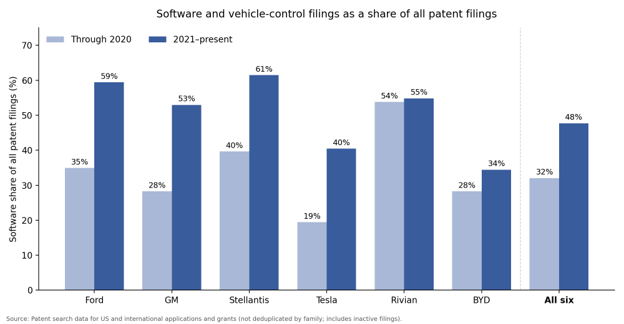
    Across the six companies combined, software and vehicle-control filings rose from about 32% of all patent filings through 2020 to about 48% since 2021. The shift is even sharper in the US, where these filings now account for about 61% of the companies’ US patent applications, up from 44%, and about 56% of their US granted patents, up from 30%.
     IP Graph

    Software and vehicle-control filings as a share of each automaker’s total patent filings (US and international applications and grants), through 2020 versus 2021 to present.

    The established automakers show the most dramatic change in share. Ford’s software and vehicle-control filings grew from 35% of its total filings to 59%, GM’s from 28% to 53%, and Stellantis’s from 40% to 61%. In US patent applications alone, these filings now represent 66% of Ford’s applications, 61% of GM’s, and 71% of Stellantis’s. Tesla has moved at a similar pace, with its share rising from 19% to 40%. In short, companies long known for mechanical engineering now direct most of their new patent activity toward software-driven technology.

    The EV-focused manufacturers, by contrast, stand out for the pace of their filing volume. Rivian, which does not appear to hold any patents filed before 2016, has filed 570 US software and vehicle-control patent applications since 2021, compared with 95 through 2020. Its software and vehicle-control filings overall have grown more than fivefold. Software has been central to Rivian’s portfolio from the start, accounting for roughly 55% of its filings in both periods. BYD has filed more than 8,100 international software and vehicle-control applications since 2021—well above the roughly 5,400 it filed through 2020—while its US filings remain comparatively modest. Tesla’s software and vehicle-control filings since 2021 nearly equal its total for all prior years combined.

    What this means in practice

    These trends carry practical implications:

    • As software becomes the core of automotive patent portfolios, competitors, suppliers, and technology partners can expect these portfolios to play a larger role in licensing negotiations, cross-licensing, and potential assertions. 
    • Software-related inventions face particular challenges under the patent-eligibility requirements of US patent law specified in Section 101, so applications should be drafted to tie claimed features to concrete technical improvements in vehicle operation. 
    • Filing geography matters: Stellantis and BYD file predominantly outside the US, underscoring the need for coordinated global filing strategies. Businesses across the automotive supply chain should evaluate their own portfolios and freedom-to-operate positions with these shifts in mind.

    A note on the methodology

    These figures are approximate and are best read as directional. Counts were not grouped by patent family, include inactive patents and applications, and may include a small number of filings from similarly named entities. GM’s international figures also include joint ventures such as SAIC-GM-Wuling. Because the earlier period spans many more years than the later one, the most meaningful comparison is the share of filings devoted to software and vehicle-control technology, rather than raw totals.

    As vehicles continue to evolve into connected, software-driven platforms, patent strategy in the automotive industry is evolving with them. Nixon Peabody’s Intellectual Property Team will continue to monitor these developments and report on trends in automotive patent activity.

    Practices

    Intellectual PropertyPatent Litigation

    Industries

    TechnologyAdvanced Manufacturing and Industrials

    Insights And Happenings

    • Video

      Unauthorized product listings: Counterfeiting, resale, and brand enforcement

      Nov 5, 2026
    • Alert

      California law gives child influencers a new right to remove paid content

      Oct 27, 2026
    • Article

      The consumer shift in microbiome patents

      Sep 3, 2026
    The foregoing has been prepared for the general information of clients and friends of the firm. It is not meant to provide legal advice with respect to any specific matter and should not be acted upon without professional counsel. If you have any questions or require any further information regarding these or other related matters, please contact your regular Nixon Peabody LLP representative. This material may be considered advertising under certain rules of professional conduct.

    Subscribe to stay informed of the latest legal news, alerts, and business trends.Subscribe

    • People
    • Capabilities
    • Insights
    • About
    • Locations
    • Events
    • Careers
    • Alumni
    • Contact Us
    • Privacy Notice
    • Terms of Use
    • Accessibility Statement
    • Statement of Client Rights
    • Supplier Code of Conduct
    • Nixon Peabody International LLP
    • PAL
    © 2026 Nixon Peabody. All rights reserved