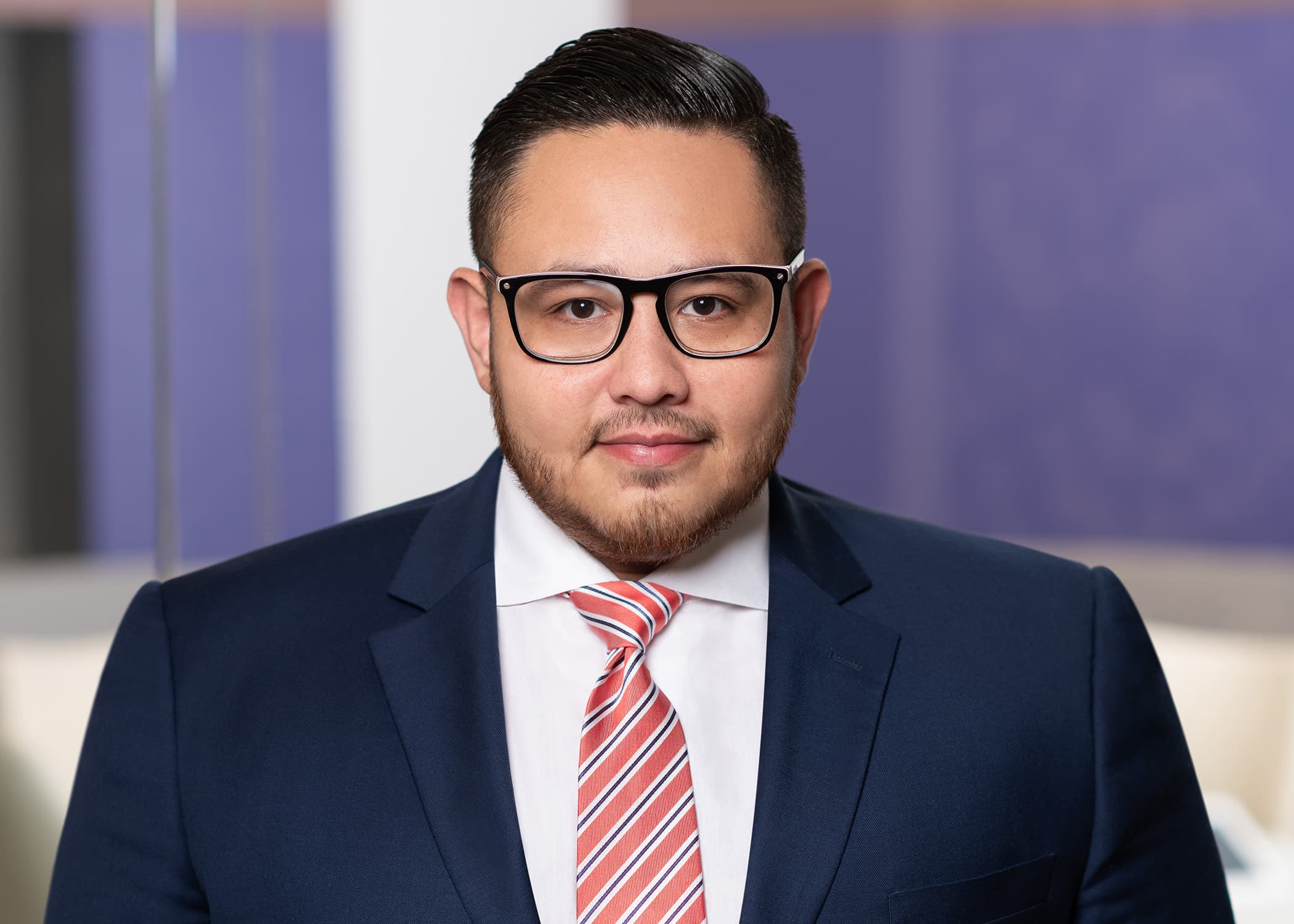

Tell us a little about yourself, your practice, and how you came to Nixon Peabody.
I represent clients in complex litigation at the state and federal levels, and I also counsel clients on resolving disputes without litigation. I earned my bachelor’s degree in Political Science from Fitchburg State University—a public university, where I developed the work ethic and practical perspective that still grounds me today—and then attended Suffolk University Law School, where I served as managing editor of the Suffolk University Law Review and graduated magna cum laude. My career began with two clerkships that continue to shape my approach to every case: first with the Hon. Gilbert V. Indeglia of the Rhode Island Supreme Court, and then with the Hon. William E. Smith of the US District Court for the District of Rhode Island. Sitting just behind the bench gave me a window into how judges think, an appreciation for the human stakes behind each case, and a deep respect for the institutions that make access to justice possible.
After my clerkships, I spent time at a top-50 AmLaw firm and then at a smaller boutique practice before joining NP. I sometimes describe my path to NP as a Goldilocks problem: the first firm was too big, the second too small, and NP has been just right in terms of its size, opportunities, and the quality of work. What keeps me here is the culture—NP really does stand for “Nice People.” It’s a place that supports me and lets me show up every day as my authentic self. I have never felt I had to hide the fact that I am gay or downplay my personal life. My husband Ethan has been genuinely welcomed by the NP community, and that matters more than any line in a recruiting brochure. Being elevated to counsel was a meaningful affirmation of the work and the firm culture we continue to build.
What inspires you? Or why do you do the work that you do?
I faced challenges coming out, but I was lucky. I grew up in Massachusetts, surrounded by family and friends who loved and supported me. Meanwhile, LGBTQ+ youth growing up in less accepting places, where the political and cultural climate is openly hostile, face challenges I was fortunate to avoid, and which are amplified amongst the most vulnerable members of our community, including LGBTQ+ people of color and transgender individuals. This inspires me to use my training and my platform to help those who have it harder than I did.
For much of my career, my work and my identity as a gay man occupied separate lanes—both mattered to me, but they rarely intersected. That changed when I had the opportunity to work alongside the ACLU of Montana and co-counsel on a constitutional challenge to a pair of Montana laws that, in practice, push conversations about gender identity and sexual orientation out of public-school classrooms and put educators at risk simply for being inclusive. Being part of that team and merging my professional skills with the community and identity that have shaped who I am has been one of the most memorable experiences of my career. I think about how those laws would have affected a younger version of me, or any LGBTQ+ kid trying to figure out who they are and see themselves reflected in the world around them. I wholly believe that the legal profession honors its ideals when it opens doors for people who have historically been kept out of the room.
What is your proudest personal or professional accomplishment?
A real full-circle career moment was the opportunity to represent a former RuPaul's Drag Race contestant in a dispute over the name she has built her career around for more than a decade. As a longtime fan of the Drag Race franchise and the community it propelled into the mainstream, getting to stand alongside one of its artists in a legal matter, as her lawyer, has been genuinely surreal. What made this work especially meaningful is who our client is: an openly trans woman who did not come from means, who has publicly shared the vulnerabilities and difficulties leading to the platform she has today, and who has had to fight for everything she has built. Being trusted to represent her in this fight is something I will carry with me for the rest of my career.
Personally, my proudest accomplishment is the life my husband Ethan and I have built together. We were married last October, and we live just minutes from the beach with our fur babies— Loki, our German Shepherd, and Sushi, our cat. For a long time, I was not sure that a husband, a home by the water, and a wedding surrounded by the people who love us was something I’d ever have. I do not take it for granted, especially during Pride Month.
As we celebrate Pride Month, are there any LGBTQ+ lawyers who have inspired your career, and why?
Coming out was not a single event—it happened in phases, starting with the people I perceived as “safe.” In law school and my early roles, I worried that being out might affect my career, particularly in more traditional environments. I was single at the time, which made it easy to sidestep the question. If anyone asked if I had a girlfriend, it felt simpler to let the assumption stand.
While it is hard to name a single LGBTQ+ lawyer who served as my formal mentor, I drew inspiration from a long line of people living out and proud well before I was ready to do the same—friends, classmates, and lawyers I encountered in my early jobs. Their courage, more than any individual conversation, is what eventually gave me permission to stop sidestepping the question. As you move up the ranks of the profession, there are still significantly fewer openly LGBTQ+ people in those most sought-after roles. That makes the lawyers who are openly carving out their lanes all the more important to me. They are demonstrating what is possible, and I try to be an example for junior LGBTQ+ attorneys making their way. I am also inspired by my peers on the Massachusetts LGBTQ Bar Association board, whose advocacy on behalf of our community reminds me that mentorship extends in every direction.
Are there LGBTQ+ professional organizations that you have been involved in, and how have they impacted you/your career?
I am co-chair of the board of directors of the Massachusetts LGBTQ Bar Association, and I have served on its board for several years. I am also a member of the National LGBTQ+ Bar Association and Nixon Peabody's LGBTQ+ Network Group. The MA LGBTQ Bar, in particular, has given me a community of colleagues and friends across firms, government, and the bench—people I can call for advice, collaborate with on impactful work, and celebrate with when our community wins. One of my favorite events is the MA LGBTQ Bar’s annual gala, which honors our community’s growth and visibility within the broader bar.
For young LGBTQ+ lawyers, what advice could you offer them for developing their career journey?
Bring your whole self to work. Whatever fear or insecurity you have about being open will be offset by the weight that lifts the moment you no longer have to hide part of who you are. When you stop strategizing about what to share and with whom, you free up an enormous amount of energy to focus on what actually matters: being a great lawyer and doing great work for our clients. There will be people in the profession who do not support LGBTQ+ people or their lifestyle, but I see that as their work to do, not ours. The lawyers and clients whose opinions are worth considering are the ones who meet you fully as you are. Find mentors and sponsors—they do not all need to be LGBTQ+—and be generous with your time when your juniors seek the same. Say yes to the bar association committee, the pro bono case, and the speaking opportunity that scares you a little; that is usually where growth lies. And remember that your identity is not separate from your value as a lawyer—it is often the source of the perspective, empathy, and judgment that clients value.
What are some of the ways you have been involved in advancing NP's commitment to diversity, equity, and inclusion?
I show up in the ways I can be most useful—participating in the firm's LGBTQ+ Network Group, mentoring LGBTQ+ law students and junior attorneys, and taking on pro bono matters that advance LGBTQ+ rights and support underserved communities. Being named a 2026 NP Pro Bono Champion has been particularly noteworthy in that regard.
A lot of my advocacy is much simpler than any program or title. It is bringing Ethan to firm-sanctioned events, mentioning him loudly and proudly when a colleague asks what I am doing this weekend, and letting my whole life be visible at work, on purpose. If a summer intern, a junior associate, or anyone else who is quietly weighing whether they can be themselves here sees me doing just that and feels even a little more comfortable sharing their own life, then I have done something meaningful—probably more meaningful than anything I could put on a panel agenda. I also see my external leadership and the writing and speaking I do on issues facing our profession as a visible extension of Nixon Peabody's commitment to being a place where LGBTQ+ lawyers can build successful careers.